

Hello from Ailsa and Beccy
Welcome to another edition of Hire Wire. This month, we’re exploring the decisions that shape successful businesses and careers. We ask whether we’re promoting the right people into leadership, look at the cost of delaying recruitment as Wellington’s market begins to shift, and share the remarkable career journey of Alliance Project Director Hugh Milliken, whose resilience and leadership have taken him from forestry to some of New Zealand’s largest infrastructure projects. We hope you enjoy another edition of Hire Wire, celebrating the people and ideas driving our industry forward.
Are we promoting the right people?
Something we’ve noticed working with businesses in New Zealand is how often loyalty and length of service can influence who gets promoted into leadership positions.
And we understand why.

Someone has been with the business for years. They’re reliable, they know the organisation inside out, they understand the customers, the systems and the way things get done. They’ve shown commitment, and naturally, we want to recognise and reward that.
So, when a leadership position becomes available, promoting that person can feel like the obvious next step.
But there’s an important question we sometimes forget to ask:
Can they actually lead people?
Being excellent at your job and being able to lead others are two very different skill sets.
A great team member may have years of technical knowledge and experience, but leadership requires something else. It requires the ability to communicate clearly, have difficult conversations, delegate, give constructive feedback, manage different personalities, build trust and bring out the best in other people.
Those qualities don’t automatically appear because someone has been with the business for ten years.
And when we get this wrong, it’s not only the team that suffers.
We can take someone who was confident, capable and highly respected in their previous role and put them into a position where they suddenly feel out of their depth. Instead of rewarding them for their loyalty, we’ve potentially set them up to fail.
Meanwhile, their team is experiencing the consequences of having a manager who may know the business exceptionally well but doesn’t yet know how to lead.
Perhaps the real question isn’t whether someone deserves recognition or progression. It’s whether leadership is the right way to give it to them.
Loyalty absolutely should be rewarded.
But promotion into people leadership shouldn’t be the only way we recognise a valuable long-term employee. There can be other opportunities such as increased responsibility, remuneration, senior specialist roles, mentoring opportunities and greater influence within the organisation, without automatically making someone responsible for leading a team.
So, before promoting someone into leadership, it may be worth asking:
1. Do people naturally go to this person for guidance, not just answers?
2. Can they have a difficult conversation without avoiding it or making it personal?
3. Can they delegate, or do they believe it’s easier to do everything themselves?
4. Can they give feedback that helps someone improve?
5. Do they genuinely want to develop other people?
6. Can they manage someone they don’t particularly like?
7. How do they respond when someone challenges their opinion?
8. Are they comfortable being accountable for someone else’s performance?
9. Do they want to lead, or do they simply see management as the next step up?
That last question is an important one.
Not everyone wants to lead people, and not everyone needs to become a manager to progress in their career. Sometimes our best people can make their greatest contribution by continuing to do what they’re exceptionally good at, while being given other opportunities to grow and be recognised.
When someone does show leadership potential, give them opportunities to develop it before handing them the title. Let them mentor someone, lead a project, run a meeting or take responsibility for developing another team member.
Prepare people to lead before asking them to lead.
Because ultimately, the best person for the next leadership position isn’t necessarily the person who has been there the longest.
It’s the person who has the ability and the preparation to bring out the best in everyone around them.
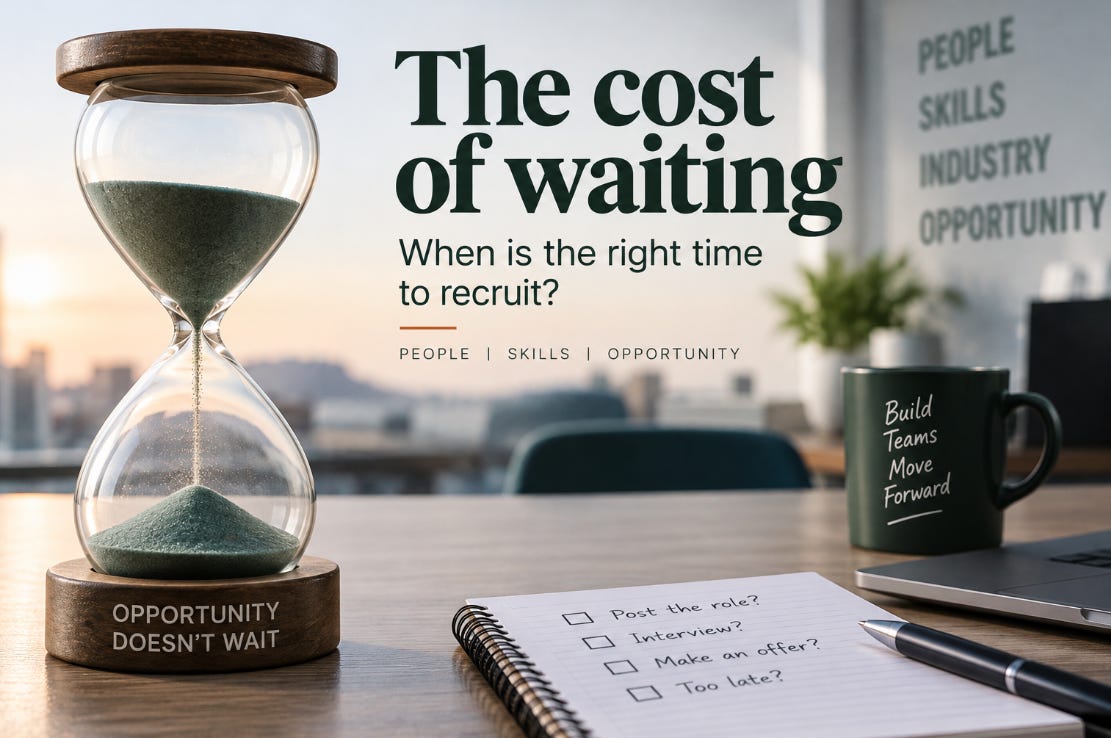
The cost of waiting: When is the right time to recruit?
There is a sense that Wellington is at a bit of a turning point.
Winter has been challenging for many businesses. The oil crisis added another layer of uncertainty, and with a general election approaching, it is understandable that businesses are being cautious about what comes next. The 2026 General Election will be held on 7 November.
But we’re also starting to hear a change in the conversations we’re having with clients.
Work is starting to come through.
That creates another challenge. When is the right time to start recruiting?
Do you wait until the work is confirmed and you know you can justify the additional cost? Or do you secure the right person now so you’re ready when the work arrives?
Waiting can feel like the safer financial decision, particularly after a quieter period. But there is also a cost to waiting.
If you’re seeing the market beginning to move, chances are your competitors are seeing it too.
And if everyone waits for certainty before recruiting, we could suddenly have multiple businesses looking for the same skills at the same time.
That person you’re considering today may not still be available next week.
So perhaps the question isn’t simply:
Can we afford to hire this person now?
It might also be:
What will it cost us if we don’t?
What happens if the work arrives and you don’t have the people to deliver it? Could you lose the opportunity? Put additional pressure on your existing team? Pay overtime? Delay a project? Or end up hiring someone who isn’t quite right simply because you need somebody urgently?
What is the cost of finding the perfect person, deciding to wait another week, and discovering they’ve accepted another role?
None of this means businesses should recruit people they don’t need or take unnecessary financial risks.
It means the decision needs to consider more than the salary you’ll pay between now and when the work starts.
Think about the cost of being ready versus the cost of not being ready.
Could you bring someone on slightly earlier and use that time for training and onboarding? Could they help with existing workloads, systems or projects while things ramp up? Could you use temporary or flexible staffing until you have greater certainty?
Sometimes waiting will absolutely be the right decision.
But if you’ve found someone with the skills, attitude and experience you’ve been looking for, it’s worth remembering that you’re not making that decision in isolation.
Your competitors may be deciding whether to hire that same person too.
In a changing market, timing can make all the difference.
My Job, My Story
Hugh Milliken
Alliance Project Director – McConnell Dowell - Otaki to Levin
What were you like when you were younger? Did you know what you wanted to do?
I came from a pretty broken home. My dad died when I was 10, and the family kind of fell apart. There was a lot of disruption, and I was pretty lost for a lot of years.
I ended up working in forestry, making good money and, as I like to say, killing trees. Then I had a pretty bad accident. On the way out in the ambulance, I realised I’d got the maths wrong. I was earning really good money, but it suddenly hit home that I was actually risking my life for it.
I was the first person ever to survive being struck by the main road crane, so I really shouldn’t be here. Somehow, I managed to survive.
After the accident, my employer, Carter Holt, moved me into the sawmill. I started as a leading hand, then became a foreman, and eventually ended up running the night shift. I was only 21 years old.
They put me on a leadership programme. I was the youngest leading hand they’d ever had on it, and the youngest white guy on the programme as well.
Was there a key moment in your life that kick started your career?
One day, I was sitting in the side shed feeling pretty good about myself. I had a sweet little car, a bit of money in my pocket, and life seemed to be tracking along okay. But there were two things going on.
The first was that my girlfriend had gone away to medical school. I’d been down to a party in Dunedin, and there were all these good-looking young men hanging around her. They all looked like they had bright futures. They were going to be doctors. Standing there, I realised my sawmill cadet career didn’t really stack up in that crowd. It was a tough comparison.
The second thing was even more significant. One morning, completely out of the blue, I was sitting in the smoking room and watched the guy who ran the sawmill drive up the access road to his office. This was a $300 million facility, and here was the boss driving a Nissan Maxima and wearing a poo-brown suit.
I remember thinking, Oh my God. I could work here for the next 35 years, and that’s the golden ticket. That’s the prize.
That thought hit me like a bolt out of the blue.
I was reading a book at the time, and that day I wrote across the top of one of the pages: I’ve got to get the fuck out of here.
That was the start.
From there, I started asking questions. How do you decide what to do with your life? How do you figure out where you’re going? I genuinely didn’t know. No one had ever taught me how to make those kinds of decisions.
What’s a great piece of advice that you received from someone?
I don’t even know how the conversation came up, but I ended up talking to this old boy, and he said, “If you’re not sure what you want to do, go and ask your mother what you did when you were three.”
And I thought, Let’s go right there.
At the time, I didn’t really have a relationship with my mother. It was all pretty rough. But I rang her anyway and said, “Hey, question. When I was three, what did I get up to?”
And she said, “I could just never get you out of the sandpit. All you did was build roads and bridges all day.”
As soon as she said it, this massive light bulb went off in my head. I was like, Oh shit, I want to build stuff. I want to be an engineer. I want to get into construction.
It really was sudden. There was no gradual epiphany. It just landed.
The second piece of advice I got was from another old boy. Just another random old boy, really.
He said, “If you’re going to do civil engineering, if you want to run jobs, you’ve got to get your head around the fact that you’re never coming back here.”
By here, he meant Nelson.
He said, “You need to understand that you’re saying goodbye to Nelson. If you want to do this properly, if you want to run the biggest and baddest jobs, New Zealand isn’t big enough. Australia’s not really big enough either. You’ve got to accept that you’re going to be mobile if you want to make the most of this career.”
His point was simple: you’ve got to go where the jobs are, and where the jobs are will keep changing.
What did you do with that advice?
Well, I’d been to five different high schools. I had what I like to call a highly developed sense of humour. In reality, I was a little shit.
I did exactly what a lot of smart kids do. School came easily, so I never learned how to apply myself. I never learned how to study properly or how to work at something when it got difficult. Then you hit the point where natural ability isn’t enough anymore, and suddenly everyone else catches up because they’ve learned the skills you haven’t.
By the time I was 16, I bailed out of school altogether. I’d been through five high schools and had a bit of a reputation following me around.
Then, when I decided I wanted to become a civil engineer, I sat down and worked out the steps.
I went to the library and read a few books. I started asking questions and figuring it out for myself.
The first thing I discovered was that I couldn’t get directly into an engineering degree. So I worked backwards. What’s the pathway into engineering?
The answer was pretty simple: I had to go back to high school.
So I stopped work and enrolled. I lived on a student allowance, but the way I saw it, I was giving up years of forestry earnings, so it felt incredibly expensive.
I was 26 when I finally pulled the pin.
To get into engineering, I had to go back and do maths, physics, and technical drawing. Because I didn’t want to waste money on accommodation, I lived in the ceiling space of a student flat in Dunedin. It was all I could afford, and I was determined to keep my costs down.
I spent a year doing School Certificate and Sixth Form subjects, effectively going back and rebuilding the education I’d walked away from ten years earlier.
I went hard. I treated study like a full time job.
I came first in the country in physics, first in maths, and first in technical drawing. Looking back, it wasn’t magic. I was only taking three subjects, and I worked on them all day, every day. I knew I had to smash it, so I did.
That got me into a two year engineering programme. I treated that like a job as well. After that, I had to complete three years working in engineering, so I took a role as an engineering foreman.
I could drive a digger, read plans, and run crews, but in hindsight, those three years were probably the most valuable education I ever received.
During that time, I ran somewhere between 60 and 80 projects from start to finish. It felt a bit like being James Bond. I’d get handed an envelope with a budget and a set of plans, then head off to wherever the job was. I’d assemble a crew, hire the equipment, organise materials, set up the site, deliver the project, and move on to the next one.
Looking back, it’s crazy they gave me that level of responsibility, but they did.
The beauty of it was that I got to make mistakes early and often. I hired the wrong gear, hired the wrong people, worked with bad budgets, dealt with weather delays, difficult clients, and every other problem that comes with running projects. Over and over again, I learned how to start a job, execute it, and finish it.
It was an incredible apprenticeship in leadership and project management.
I also had a little ritual. Whenever I finished a project, I’d check the numbers. If we’d made money, I’d take myself out to the fanciest restaurant in town, wherever I happened to be. If we’d lost money, I’d grab a burger from a takeaway shop, drive out of town, and spend the trip home thinking, “Well, I fucked that one up. I’ll do better next time.”
When did the penny drop for you that you might be good at this?
I then moved up to Wellington
The company I was with was still basically a start up. It was two directors driving Camrys with all their credit cards maxed out. We were on the ragged edge all the time.
In hindsight, that was great discipline. It taught me that it is not just about what the job needs. It is also about what the business needs.
We had won what was, for us, a huge job. It was worth half a million dollars. Then the directors rang me and said, “There’s a problem.”
They had forgotten to include the transport cost for all the piles. The piles were being made in Hamilton and had to be moved to Wellington, but that cost was missing from the bid.
I asked, “What do you need from me?”
They said, “We need you not to lose one dollar, because if you do, we’ll go broke. You cannot fuck this up.”
So we stripped everything back. I put the whole crew in a two bedroom unit, and I slept in the wagon or in the shipping container on site when no one was looking. We worked our asses off. I did one of the labourer’s jobs myself and acted as the dogman as well. I unloaded trucks at night so we could save every dollar possible.
We were on that job for about six weeks. I think we made something like $2.75. But we did not lose money.
When it was over, I did not take myself out for the fancy meal. I took the boys out instead, because they had worked their asses off. I had sold them the seriousness of it from day one. I told them, “This is serious business. We have to get this right.”
Driving out of town afterwards, I realised something had changed. After three years of practice, I was actually getting good at this. I could execute a job under pressure, protect the business, and get the team across the line.
What keeps you motivated when work gets challenging?
On the Coromandel job, the mission was simple: get the road open by Christmas.
The communities on the other side were hurting. People would drive up to the site with pies, free cokes, and thank you notes because their businesses were struggling. They needed that road open.
I actually drove around the long way and spent a weekend in those towns. I wanted to understand what was really at stake. I wanted to be able to come back and tell the team about the people behind the project. People like Auntie May, running the local pie shop and wondering how much longer she could keep the doors open.
That’s what gets people moving. When they understand the mission and who they’re doing it for, they buy into it completely.
Even now, I’ve got my own people out on that road every day. The work matters because it’s not just about building infrastructure. It’s about the communities that depend on it.
How have expectations of major projects evolved over the years?
I think it’s really about social licence. The expectations around major projects have changed dramatically over the years.
When I first started in the industry, we’d roll into a small town with one goal: get the job done. We’d hire all the local gear, all the pumps, all the equipment. We’d bring in dozens of workers, fill up the pubs every Friday night, and generally create havoc. We didn’t spend much time thinking about the impact on the local community because, back then, there was only enough money and focus to deliver the project.
Today, the expectations are much broader. It’s no longer just about building the road, bridge, or tunnel. It’s about creating local jobs, developing cadets, working with iwi, supporting local businesses, protecting the environment, and leaving the community better off than when you arrived.
That’s a good thing. Projects have become much more connected to the communities they serve.
I’ve never been the smartest person in the room. I didn’t get first class honours, and that’s okay. What I’ve become good at is working through complex problems, figuring out what actually matters, and bringing people together around a common goal. A lot of that comes down to emotional intelligence as much as technical skill.
What has been one of the biggest learning moments of your career?
A lot of my career was built on lessons learned from watching both good and bad decisions.
One of the biggest lessons was to trust my own judgement. Early on, I sat in meetings where experienced people made decisions that simply didn’t make sense. At first, I assumed I was missing something. Later, I realised that sometimes they were just wrong. That taught me to back myself, even when I was the youngest person in the room.
I also learned that leadership is about creating an environment where people can challenge ideas. On my projects, anyone can question a decision, including mine. The standard is the standard, and nobody gets a free pass because of their title.
Over the years, I worked on major projects across New Zealand and Australia. I saw projects succeed, projects fail, and projects get cancelled for reasons completely outside the team’s control. I dealt with difficult negotiations, commercial disputes, safety incidents, and more than a few expensive mistakes.
One turning point came when I realised I couldn’t keep succeeding through sheer force of will. I’d spent years trying to be the smartest person in the room, working harder than everyone else and carrying too much myself. Eventually, I burned out.
That forced me to rethink how I led. Instead of trying to do everything, I learned to trust people, build strong teams, and focus on creating the conditions for others to succeed. That shift changed my career.
From that point on, opportunities started opening up. I moved into larger leadership roles, ran increasingly complex projects, and discovered that my real strength wasn’t technical expertise. It was bringing people together to solve difficult problems.
Looking back, the biggest lesson is that success comes from a combination of resilience, curiosity, and humility. You have to be willing to make mistakes, learn from them, and keep moving forward. Every project, every setback, and every challenge adds another layer of experience that you simply can’t get any other way.
What do you do to unwind after work?
I love sailing and drinking whisky.
Thank you to Hugh for taking the time to talk to me.
Beccy