

Hello from Ailsa and Beccy
This month it’s all about health and safety, but not the box-ticking kind.
The biggest changes to the Health and Safety at Work Act since 2016 land on 1 April 2027. Our first reaction was “business as usual”, but looking closer made us rethink a few things, especially how we get our people to speak up when something doesn’t feel right. We share what’s changing, what it means when you’re the employer but not the one running the site, and how our app is becoming one of our most important safety tools.
We’re also proud to share that Key Skills is now an official ConstructSafe assessment centre. We look at why testing what someone actually knows can be smarter than sending them on yet another course, and how you can book your team in.
Let’s get into it.
Ailsa & Beccy
Business as usual? Not quite.
What the April 2027 health and safety changes mean when you’re the employer, but not the one running the site.
When I first read through the changes coming to the Health and Safety at Work Act, my honest reaction was: business as usual.
We employ 200 to 300 people on site every week. Health and safety isn’t something we pick up once a year. We like to think we punch above our weight here.
But the more I’ve sat with it, the more I’ve realised “business as usual” isn’t good enough. Not because we’re doing it wrong, but because the changes shine a light on the one thing that’s always been hardest for us.
What’s changing?
The Health and Safety at Work Amendment Act 2026 became law in July, and most of it kicks in on 1 April 2027. It’s the biggest shake-up since the Act came in back in 2016.
The short version:
Critical risks come first. A critical risk is one likely to cause death, a hospital-level injury or illness, a serious incident, or an occupational disease. Some are automatically critical, including asbestos, working at height (over 3 metres), excavations, scaffolding, machinery and plant, cranes, hazardous substances, dust and fumes, noise and remote or isolated work.
Small and large businesses are treated differently. Fewer than 20 workers (for at least nine months of the year) is a “small PCBU” and must focus on critical risks. Twenty or more is a “large PCBU” and must manage all risks, with critical risks at the top of the list.
Following an Approved Code of Practice now counts. Follow the relevant ACOP for a risk and you’re considered to have met your duty for that risk.
Directors’ duties are clarified to focus on governance: understanding the risks, making sure the resources are there, and checking they’re actually being used.
One more thing worth knowing: the reforms have been politically contested, and some commentators expect them to be revisited after the election. Plan for April, but keep an eye on it.
The tricky bit for us (and maybe for you)
Here’s our reality. We are the employer of every temp we place. Legally, we’re their PCBU. But we’re not in control of the site. You are.
That means we share the duty. Where two businesses have duties to the same workers, the law says they must consult, cooperate and coordinate. You can agree to do more than the minimum, but nobody can contract their duty away.
The new rules add a wrinkle. If you’re a small business, your legal focus narrows to critical risks. We’re a large PCBU, so we still have to manage all the risks our people face, on your site. Which means we need to know about them.
And that brings us to our biggest challenge. It isn’t paperwork. It’s communication.
How do we get our people to tell us when they don’t feel safe? And how do we pass that on to you without it turning into a fight, or costing us a client?
We’ve covered this before in Hire Wire. Workers who feel they’ll be “that guy” for speaking up usually just stay quiet. Until someone gets hurt.
What we’re doing about it
This year we launched our app for our temp workforce. Uptake isn’t at 100% yet, but the early signs are really positive.
Through the app, every worker has:
Direct access to everyone at Key Skills, from their consultant right through to management
A confidential way to raise a concern, without having to say it out loud on site
Short how-to videos for when they’re not sure about something
Looking closely at the law changes made us realise this isn’t just a handy tool. It’s one of the most valuable safety resources we have.
So between now and April we’re building it out. More videos, focused on the critical risks our people are most likely to meet. Then short quizzes, so workers can show they understand the key high-risk areas (think asbestos awareness, working at height and mobile plant) before they need that knowledge on site.
And when someone does speak up?
This is where we need you.
When a concern comes to us, we’ll raise it with you directly and early. We’re not doing it to catch anyone out. We’re doing it because you’d want to know, and because fixing something small is a lot easier than explaining something serious.
The best sites we work with already treat this as teamwork. A quick call, a fix, and everyone gets on with the job.
A few things worth doing before April:
Work out whether you’re a small or large PCBU, and what your critical risks are
Talk to us about how we’ll share safety information both ways
Make sure site inductions cover your critical risks clearly, including for temps who start at short notice
Make speaking up easy and judgement-free, for everyone on site
Over to you
We’d love your input. What topics would be most useful to cover in our worker videos and quizzes? What do you wish every temp knew before they walked onto your site?
Flick us a message at safety@keyskills.co.nz
Because the safest sites aren’t the ones with the thickest folders. They’re the ones where people feel safe enough to say, “Hang on, that doesn’t look right.”
Read more: WorkSafe: Understanding the changes · What is a critical risk? · Working with other PCBUs
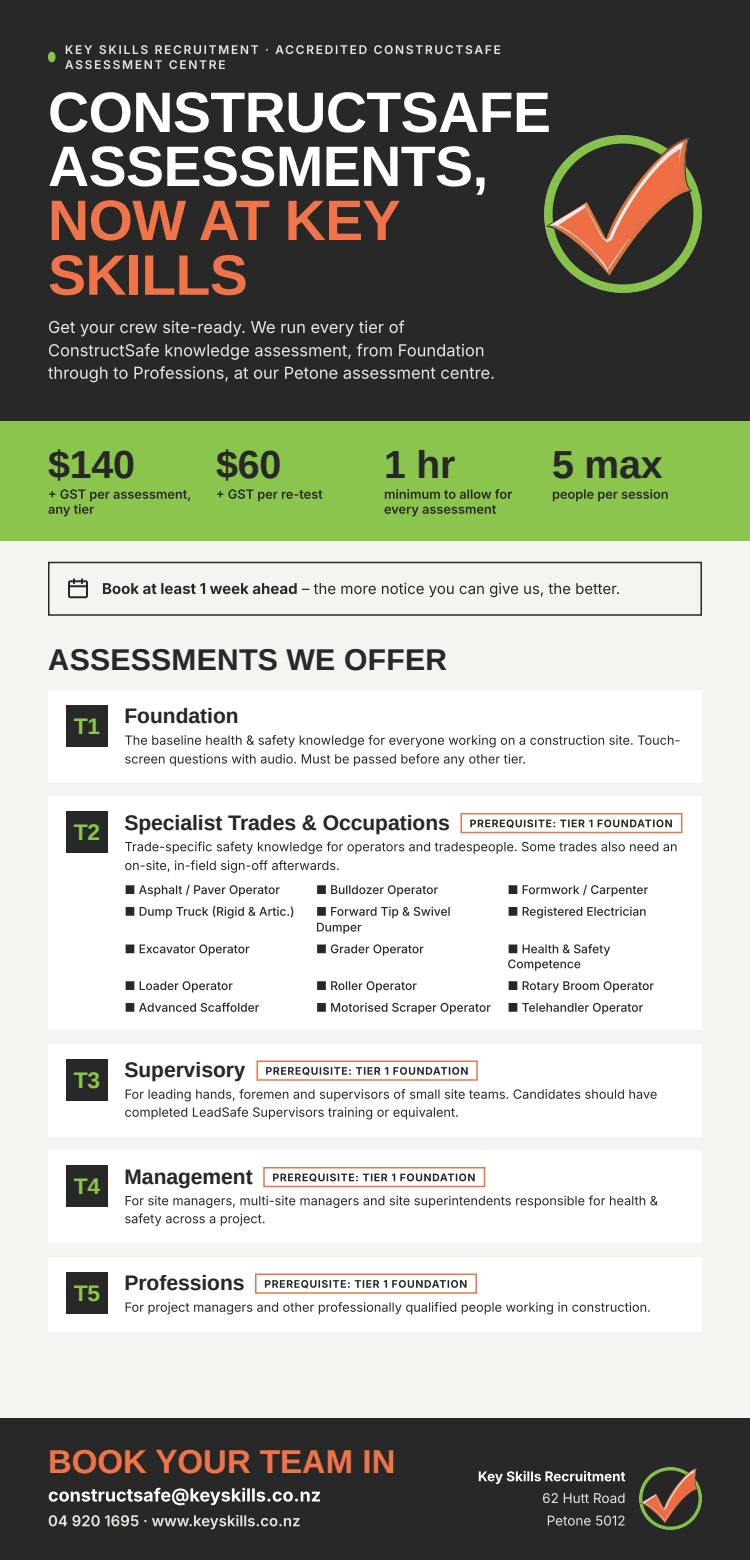
Dont just train it. Test it.
Key Skills is an official ConstructSafe assessment centre, with three sessions running every week.
Here’s a question worth asking about your team: how many health and safety courses have they been on? Now a harder one. How much of it do they actually know?
Those two answers aren’t always the same.
The certificate trap
We’ve all seen it. Something goes wrong, or a contract needs ticking off, and the answer is another course. A day off site, a certificate in the folder, and everyone feels a bit better.
But sitting through a course doesn’t prove someone understood it. And it definitely doesn’t prove they remember it six months later, standing next to an excavation at 3pm on a Friday.
Training has its place, and good training is worth every cent. But if you don’t know where someone’s gaps are, you’re just guessing. You might be paying to teach an experienced hand what they already know, while missing the one thing they don’t.
Test first, then train
That’s where ConstructSafe comes in.
ConstructSafe is the construction industry’s own health and safety competency assessment, overseen by CHASNZ (Construction Health and Safety New Zealand). Instead of asking “have you done the course?”, it asks “do you know your stuff?”
It’s an independent check of what someone actually knows. The results sit on an online profile that clients and principal contractors can check, whoever the worker’s employer is.
There are five tiers, so there’s a fit for everyone on site:
Tier 1: Foundation health and safety knowledge for anyone working on a construction site
Tier 2: Specialist trades, such as plant operators and scaffolders
Tier 3: Supervisors leading small teams
Tier 4: Site managers and superintendents
Tier 5: Professionals, including project managers, health and safety advisors, engineers and designers
Why it makes sense
You see the real picture. You find out what your people know, not what’s on paper.
You spend training money where it counts. If the gap is in working at height and not hazardous substances, train that. Skip the rest.
It respects experience. Good workers who know their stuff get the recognition, without sitting through the same course for the fifth time.
It travels with them. A recognised result that clients and head contractors already know and trust.
It’s good timing. With the health and safety law changes landing on 1 April 2027 and a sharper focus on critical risks, being able to show your people genuinely understand the risks is only going to matter more.
And for workers, it’s a confidence boost. There’s something to be said for proving you know your job.
Why we’re doing it
We place hundreds of people on construction sites every week. For years we’ve been the ones checking that our people are safe and ready. Being an accredited assessment centre feels like a natural fit.
It also fits how we think about people. You can train skills, and you should. But first, find out where someone’s really at.
How to book
We run three assessment sessions every week at our Petone office, covering Tiers 1 to 5.
Whether it’s one new starter or your whole crew, get in touch at constructsafe@keyskills.co.nz for more details or to book a spot.
Because a certificate tells you someone turned up. An assessment tells you they know what they’re doing.
My Job, My Story
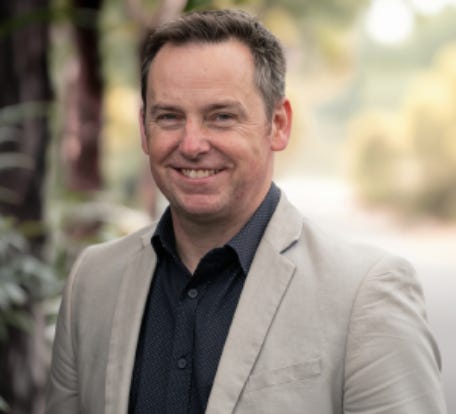
At 23, Mark Skelly was managing a team responsible for $100 million of surgery funding. He’d originally planned to be a pilot. In this month’s My Job, My Story, the Red Hot Business Coaching co-owner shares the unexpected turns, tough lessons and mindset shifts that shaped his career.
Co-owner of Red Hot Business Coaching -22 years
President of the Hutt Valley Chamber of Commerce
Did you know what you wanted to do when you were younger?
Yes. I was one of those annoying kids who knew exactly what they wanted to be. I wanted to be a pilot. I’ve always loved flying, and the plan was to join the Air Force.
Through the Air Training Corps, I had the opportunity to spend three weeks learning to fly with the Air Force when I was 17. I even flew solo in an Air Force aircraft, which was epic. But being there also gave me a glimpse of the reality. The pilots didn’t seem particularly happy, they weren’t flying much, and there were budget pressures. I started wondering whether it was really what I wanted.
The Air Force had encouraged me to get a degree and come back when I was older, so I went to university and completed a science degree. By the time I’d finished, I’d decided I wanted to become a commercial pilot instead.
I borrowed money and spent a lot learning to fly, but by about 120 hours I was questioning that path too. Talking to people in the industry, I realised that loving flying and wanting to do it for a living were two different things. There weren’t many of the commercial jobs I’d imagined, and the reality wasn’t quite the dream. Maybe I’d watched too much Top Gun and wanted to be Maverick!
I got my private pilot licence, did gliding and quite a lot of flying, but eventually decided it was something I’d rather enjoy as a hobby. There’s a joke I like: “How do you know if there’s a pilot in the room? Don’t worry, they’ll tell you.” I haven’t flown for years now, though.
Was there a key moment in your life that kick started your career?
I’d worked in hospitality while I was at university in Dunedin, including running a little pizza shop. I can still make a pretty mean pizza. After that, I applied for a job at ACC, of all places.
Someone senior must have seen something in me when I applied, because one day early on I was called into the boss’s office. I remember thinking, “What have I done?” He told me to close the door and said, “We’re not having this conversation, Mark, but there’s a management job coming up. You should apply.” So I did, and I got it.
I was about 23 years old, taking over a team responsible for funding about $100M of surgery. The process was fairly new, there was a huge backlog, and the private hospitals we dealt with were deeply unhappy. The previous manage, who had made a mess of things, had been demoted back into the same team, so there I was, managing someone roughly twice my age who had previously been in charge. I had no idea how difficult a situation I was walking into.
It was a massive learning experience. I worked incredibly hard, learnt a lot about people and leadership, and eventually got the previous manager on side. The team turned things around, and we started getting positive feedback from hospital CEOs and ACC’s CEO. From there, I was asked to help fix other parts of the organisation, and more teams and responsibilities kept getting added.
One thing I came to understand about myself was that I could see both the big picture and the detail. Some people are brilliant at one but struggle with the other. I could move between them, and I was also willing to have difficult conversations without making them confrontational.
I spent about six years at ACC. For a year, I flew between Dunedin and Wellington every week while centralising a process worth about $600 million, before eventually moving to Wellington. We doubled one team’s productivity three years in a row, and it also had the highest staff satisfaction in the country within ACC. Looking back, it was an incredible place to learn about change, systems and helping people work more effectively.
What led you to start Red Hot Business Coaching?
I was investing a lot in my own development, both through work and personally. My wife and I were also learning about property investment, going on courses and paying for mentoring. That’s where I met Lance, who became my business partner.
We were both in our late twenties, and most of the people in the mentoring group were considerably older. Lance (Business partner) and his wife, and my wife and I, were the ones getting out there and doing deals. That’s when we realised that we should do something together.”
We thought in similar ways and had similar abilities, but enough differences that we each brought something useful to the table. That was the beginning of what eventually became Red Hot.
At ACC, the next step would have been moving into very senior management. To me, that looked increasingly political, and I wanted to spend my time doing productive work rather than navigating that side of corporate life. I wanted to be in business for myself.
Red Hot’s been going for 22 years now and it’s been a crazy ride, but I wouldn’t change it. I’m a better person for having done it. One of the biggest things I’ve learnt through Red Hot is to be comfortable being me.
What advice would you give your younger self starting out?
Don’t worry so much about what other people think. In my early career, I was often 20 years younger than the people around me. Even when I was getting good results, part of me worried that someone would find out I was only 25. There was definitely some imposter syndrome.
It’s taken time to become comfortable with who I am. I don’t think those feelings ever disappear completely, but I’m much more at ease with myself now.
My grandfather said something to me on his deathbed that has stayed with me: “Don’t worry about things you can’t control.” For me, that connects closely with not worrying about what everyone else thinks. Just get on and do things.
What was one of the biggest learning moments in your career?
An early personal development programme ended with a fire walk. You look at the hot coals and think, “I can’t do that. That’s impossible.” Then you do it, reach the other side, and realise you’ve just done something you believed you couldn’t.
I remember standing at the end thinking, “What else am I telling myself is impossible that might not be?” It felt as though my world had opened up. It changed the way I thought about taking risks and about the limits I was putting on myself.
We can be our own biggest asset and our own biggest barrier. That experience really brought it home for me.
How did you become involved with the Chamber of Commerce?
Some people collect stamps as a hobby. I run a Chamber of Commerce!
Again, it started because someone asked me. A board member approached me about 13 or 14 years ago and said they thought I’d be a useful addition to the board. We’d been members, so I agreed to stand for election and got on. I fairly quickly had opinions about things, became vice president, and then president. I’ve been president for seven years.
I’m really proud of what we’ve achieved. The organisation has grown, its reputation is strong, and its improved financial performance has allowed us to make a bigger difference. That includes developing the 35 by 35 plan for the Hutt Valley’s economy.
One thing I’d wanted for a long time was a clearer picture of what our local economy actually looks like. Being able to show businesses, MPs and others the scale of the Hutt Valley, and the strength of its manufacturing sector, changes the conversation about what’s possible here.
There’s so much potential in the Hutt Valley. Being involved with the Chamber is another extension of what I enjoy most, helping people.
What keeps you motivated when work gets challenging?
Helping people. It sounds a bit clichéd, but I’ve learnt that’s what really makes me tick. One of my daughters helped me recognise it by reflecting back what she saw in the way I talked about my work at Red Hot and with the Chamber of Commerce.
Clients often come to us because they want to make more money, and improving their business results matters, and of course is a given. But what motivates me is seeing them feel less stressed, less anxious and more in control. They can take a holiday, stop working every weekend, and enjoy their lives again.
I’ve lost count of the times a partner has said, “Thank you for giving me my husband back,” or “Thank you for giving me my wife back.” One client told me that if they hadn’t been working with me over the previous year, they would have been divorced. When couples run a business together, the business relationship and the personal relationship can become very tangled.
“Early on in Key Skills when you were our coach, your advice on goal setting put us on a path that still blows my mind today. We’ll always be grateful for the part you played in helping us get here.” Beccy
What’s a great piece of advice that you received from someone?
Be yourself and be authentic. I’ve learnt so much from so many people over the years, but that’s probably the biggest one.
Another belief I try to live by is that everything is a choice. If I’m working hard and I’m tired, I’m choosing to work hard. If I’m accepting something or tolerating something then I’m choosing to.
Looking at life that way puts the ability to influence things back with me. It helps me take responsibility for what I’m doing and recognise that I can make a different choice.
Do you have any daily rituals or habits that help you succeed at work?
For long periods of my life, I’ve used a morning routine built around a series of questions. What am I grateful for today? What am I happy about today? It’s a way of appreciating what I have while also reminding myself of what I’m working towards.
One of my ongoing challenges, and it’s probably been a 30 year project, is balancing happiness and ambition. I want to enjoy what I’ve got and be grateful for it, while still wanting to grow and progress. I don’t want to focus so much on what’s next that I forget to enjoy what’s here, or become so comfortable that I stop moving forward.
The other big thing is my diary. I’m very diary based. I like knowing what’s happening each day, what’s coming up and what I need to do. I might not always get everything done, but I don’t like being surprised by things that shouldn’t be a surprise.
What do you do to unwind after work?
I’d answer that slightly differently, because I don’t really feel that I usually need to unwind. Early on, I worked hard to separate work from home. When I’m at work, I’m working. When I’m home, I’m home.
I used to drive ten minutes to the office to do ten minutes of work, then drive ten minutes home again, rather than do it at home. Otherwise, ten minutes could become twenty minutes, then three hours, and suddenly I’d spent the evening at home working. It’s not quite that black and white now, but keeping that distinction works well for me.
Outside work, I enjoy spending time with Megan and the girls, working on my classic car, a 1982 Trams Am, watching Formula 1 and walking the dog. We like travelling too, we haven’t done much over the past couple of years but have a trip to Vietnam booked early next year.so hopefully plan to get away next year.
If you could be anyone for a day, who would you be?
Probably a Formula One driver or a fighter pilot, but I’d like the fantasy version of those jobs rather than the reality!
I suspect the reality is incredibly demanding and comes with enormous pressure. The seven year old version of me still wants to do both, though. Or perhaps flying in a Red Bull air race. That would be pretty cool.
Thank you to Mark for taking the time to talk to me.
Beccy